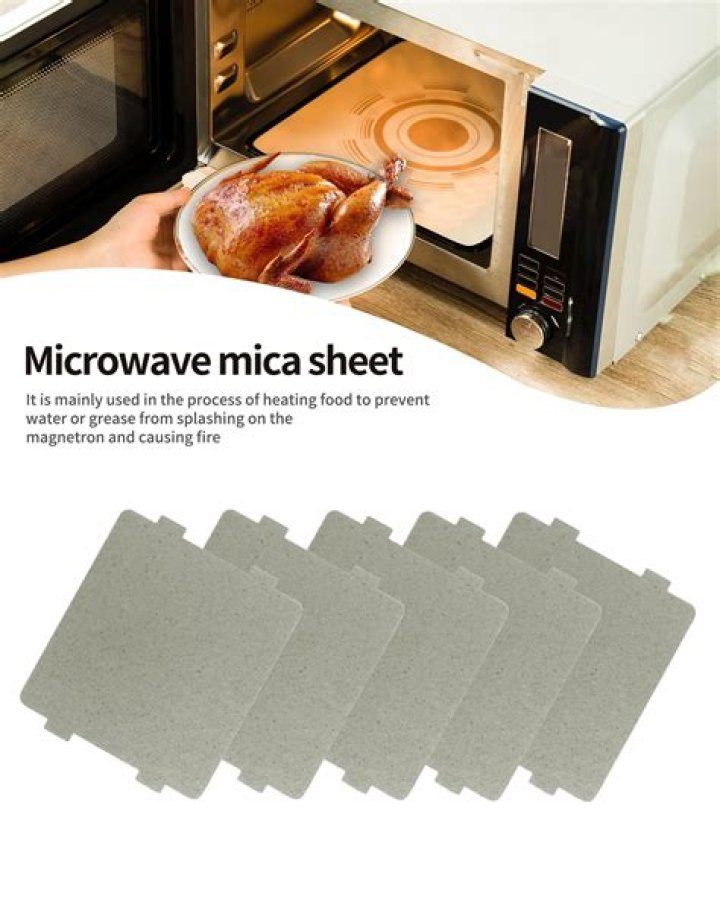
How do you cut Mica plates?
How do you replace a mica sheet in a microwave?
This is VERY dangerous, but no need to worry, all you need to do is order these
mica sheets. Then, you take out the old dirty one from the inside of the
microwave and trace it with a pencil on the new
mica sheet. Cut it with scissors and then insert it where the old one used to be. That’s it!
Can I use my microwave without the waveguide cover?
You
can use your
microwave without a
waveguide, but when the
waveguide is damaged, the steam and vaporized food particles collect on the oven’s electronic components. The
waveguide’s main function is to protect the oven from steam and vaporized food particles will accumulate on the oven’s inner electronic components.
How do I replace my Mica plate?
Can I tape a waveguide cover?
Replacement process- Carefully remove the damaged part.
- Rinse and clean the old plate from dirt.
- Cut a new part from the purchased mica / plastic sheet, using the old one as a stencil.
- Make holes for mounting.
- To grind a new plate, removing all irregularities.
- Install.
What does a mica sheet do in a microwave?
as long as the
tape doesn’t react to the microwaves you should be fine. The only purpose of the
cover is to allow microwaves through and block steam from getting onto the electronics.
Why are waveguide covers made of mica?
The
mica sheet prevents food and contaminants from reaching the electrical components – but as
mica is a dielectric, it allows the
microwaves through to heat the food. And because
mica can be produced in incredibly thin
sheets, it ensures that the appliance doesn’t become too bulky or heavy.
Do you remove the cardboard from inside a microwave?
It is usually
made of a material called
Mica. What does it do ? Its purpose is to cover the aperture through which the microwaves enter the oven cavity from where they are
produced by the Magnetron behind the control panel. It stops moisture and food particles getting into the “workings” of the microwave.
Do you need waveguide cover?
The
cardboard (mica) covers the waveguide system that feeds
microwave energy into the cavity and
should not be
removed. The
microwave should not be used for any function if this
cardboard cover is not in place. If
removed, it
would require service to replace.
How do I change my waveguide cover?
Answer: The
waveguide cover protects the gap where the microwaves enter the oven cavity from where they are produced by the magnetron. Additionally, it stops moisture and food particles from getting into the “workings” of the microwave. Replace the
waveguide cover if it is burnt, chipped, or cracked.
How do you clean a waveguide cover?
- What you will need: Waveguide Cover.
- Step 1 – Switch Off Your Appliance. Safety First!
- Step 2 – Remove The Turntable And Roller Ring. Before you go about replacing the waveguide cover, remove the turntable and the roller ring.
- Step 3 – Remove The Old Waveguide Cover.
- Step 4 – Fit The New Waveguide Cover.
Which mode is not possible in waveguide?
Rectangular and circular
waveguides are commonly
used to connect feeds of parabolic dishes to their electronics, either low-noise receivers or power amplifier/transmitters.
Waveguides are
used in scientific instruments to measure optical, acoustic and elastic properties of materials and objects.
What are the features of waveguide?
Answer. Answer: Wave travel along a standard, two-conductor transmission line is of the TEM (Transverse Electric and Magnetic)
mode, where both fields are oriented perpendicular to the direction of travel. TEM
mode is only
possible with two conductors and cannot exist in a
waveguide.
What is TEM mode in waveguide?
It has some unique
characteristics that allow for wide range of application including slow and fast light, metamaterial, low loss energy transmission, and sensing. The resemblances and differences between this
waveguide configuration and metal-insulator-metal (MIM) are discussed in this paper.
Why is there no TEM mode in rectangular waveguide?
TEM mode: The Transverse electromagnetic
wave cannot be propagated within a
waveguide, but is included for completeness. The
TEM wave is characterised by the fact that both the electric vector (E vector) and the magnetic vector (H vector) are perpendicular to the direction of propagation.
What is TE TM TEM modes?
A rectangular waveguide supports TM and TE
modes but
not TEM waves because we cannot define
a unique voltage since
there is only one conductor in
a rectangular waveguide.
A rectangular waveguide cannot propagate below some certain frequency. This frequency is called
the cut-off frequency.
Why can’t TEM mode exist in hollow waveguide?
Transverse electromagnetic (
TEM)
modes. Transverse electric (
TE)
modes. No electric field in the direction of propagation. These are sometimes called H
modes because there is only a magnetic field along the direction of propagation (H is the conventional symbol for magnetic field). Transverse magnetic (
TM)
modes.
Which condition holds good in a waveguide?
However,for a
hollow wave guide having no inner conductor,this axial current must be a displacement current. But axial displacement current requires an axial component of E,which is not
present in a
TEM wave. therefore,
TEM wave cannot exist in a single-conductor
waveguide.
Which mode does not exist in rectangular waveguide?
5. In a
waveguide, always
which condition holds good? Explanation: In air medium, the phase velocity is assumed to be the speed of light. For
waveguides, the phase velocity is always greater than the speed of the light.
Which is the dominant mode in rectangular waveguide?
In a
rectangular waveguide the lowest value of m or n for TM
mode is unity So the lowest TM
mode is TM11 ( TM01 or TM10
modes do not exist.) For TE
mode, TE10 and TE01
modes exist. The lowest order TE
mode is TE10 . This
mode has the lowest cut off frequency and is called the dominant
mode.
Does the waveguide 3x 5.5 cm exist?
Particularly, for
rectangular waveguides, the TE10
mode has the lowest cutoff frequency and so, called the
dominant mode.
What do you know by dominant mode of a waveguide?
Does the waveguide with dimensions 3
cm x
5.5 cm exist? Explanation: For a
waveguide, the dimension a should be greater than b. Here a = 3 and b =
5.5, thus such
waveguide does not
exist.
Why we Cannot use waveguide at low frequencies?
dominant mode: In a
waveguide that can support more than one propagation
mode, the
mode that propagates with the minimum degradation, i.e. , the
mode with the lowest cutoff frequency.