general
Difference between magma and lava
Written by Leah Mitchell — 0 Views
Why are magma and lava different words?
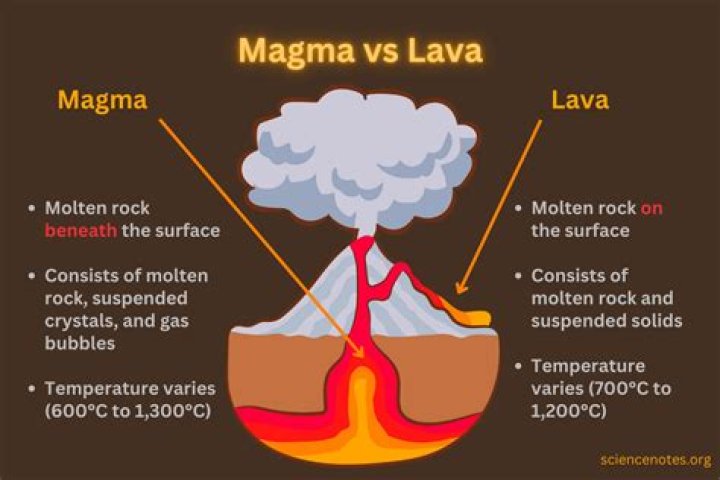
Magma comes from an Italian word that means a thick, pasty substance, which is how molten rock behaves within the Earth. Lava, another Italian word, means to slide, which is what molten rock does once it reaches the surface.What is the difference between magma and lava quizlet?
What is the difference between magma and lava? Magma and lava both refer to molten rock from which igneous rocks form. However, magma refers to molten rock below Earth’s surface, and lava refers to molten rock at the surface.Is Magma hotter than lava?
Magma is hotter than lava, depending on how recently the lava reached the surface and if the magma and lava are from the same magma chamber below theWhat is the difference between magma and lava Brainly?
Magma is molten rock within the earth; lava is molten rock on the earth’s surface. Explanation: Magma is composed of molten rock and is stored in the Earth’s crust. Lava is magma that reaches the surface of our planet through a volcano vent.What are the 3 principal types of volcanoes?
Why are volcanic eruptions damaging?
There are three types of volcanoes: cinder cones (also called spatter cones), composite volcanoes (also called stratovolcanoes), and shield volcanoes.How dangerous is volcanic ash?
How does volcanic ash eliminate you?
Volcanic eruptions can be extremely damaging to the environment, particularly because of a number of toxic gases possibly present in pyroclastic material. Sulphur dioxides cause environmental problems, because they are converted to sulphuric acid in the stratosphere; the main cause of acid rain.What are the negative effects of a volcanic eruption?
Unlike the ash produced by burning wood and other organic materials, volcanic ash can be dangerous. Its particles are very hard and usually have jagged edges. As a result, it can cause eye, nose, and lung irritation, as well as breathing problems.What are the 5 positive effects of volcanic eruption?
If inhaled, volcanic ash can cause breathing problems and damage the lungs. Inhaling large amounts of ash and volcanic gases can cause a person to suffocate. Suffocation is the most common cause of death from a volcano.What is the advantage and disadvantage of Volcano?
Health concerns after a volcanic eruption include infectious disease, respiratory illness, burns, injuries from falls, and vehicle accidents related to the slippery, hazy conditions caused by ash. When warnings are heeded, the chances of adverse health effects from a volcanic eruption are very low.What is usually a safe distance away from a volcano?
Positive effectsGeothermal energy can be generated in areas where magma lies close to the surface. This is good for increasing renewable energy use. Ash ejected by the volcano acts as a good fertiliser for soils. Volcanoes attract many tourists, who enjoy the dramatic scenery that they produce.
Can you walk in lava?
Advantages – Precious minerals; geothermal energy; fertile soil; tourism (jobs); beauty products; souvenirs. Disadvantages – Destruction during eruptions; magma/ash destroys everything; earthquakes; pollution; sea life; quarries.How overdue is Yellowstone eruption?
The safe distance from an active volcano is generally 5kms or more but you should check for the latest CDEM information. Beyond this distance the major hazards will be ashfall and volcanic gas. Breathing in small amounts of ash particles infrequently may only cause discomfort rather than pose a health hazard.What type of volcano is considered the most dangerous?
As long as you can bear the heat, it means lava is strong enough for you to walk on it. If your shoes start taking fire, just move away!Which volcano will destroy the world?
Yellowstone is not overdue for an eruption. Volcanoes do not work in predictable ways and their eruptions do not follow predictable schedules. In terms of large explosions, Yellowstone has experienced three at 2.08, 1.3, and 0.631 million years ago. This comes out to an average of about 725,000 years between eruptions.Is Vesuvius still active?
Not surprisingly, supervolcanoes are the most dangerous type of volcano. Supervolcanoes are a fairly new idea in volcanology. The exact cause of supervolcano eruptions is still debated, however, scientists think that a very large magma chamber erupts entirely in one catastrophic explosion.What are the 5 most active volcanoes?
How does a ‘supervolcano’ eruption work? Below Yellowstone National Park, there’s a huge magma reservoir that’s responsible for all the geysers and hot basins, bubbling away — and it’s precisely this reservoir that has the potential to destroy humanity.What is the most powerful volcano on Earth?
Vesuvius TodayVesuvius is still very much an active stratovolcano, with the city of Naples and its 3 million residents only a mere 12 kilometres away. Whilst these efforts are being administered, there are a multitude of visitors that come to see what the destruction of Vesuvius did to Pompeii.