updates
Difference between cpk and ppk
Written by Emily Ross — 0 Views
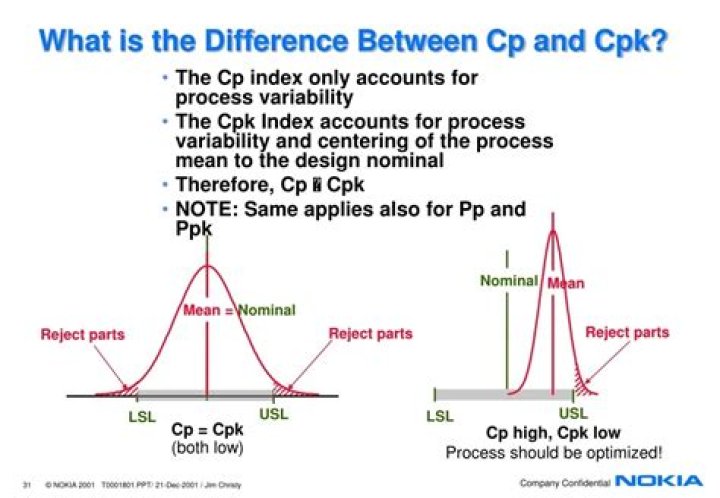
What is the difference between CP CPK and PP PPK?
Pp, Ppk vs Cp, CPKCp & Cpk use an estimate for the standard deviation using the R Bar / d2 method. Pp, Ppk are more liberal where Cp, CPK are more conservative. Use Pp & Ppk when you are initially setting up your process. Use Cp & Cpk once the process is in a state of statistical control.
Why is PPK higher than CPK?
The automotive confusion aside, Ppk will always be greater than Cpk since Ppk is long term capabliity and Cpk is short term capability. The only way that Cpk will be greater than Ppk (other than a misuse of the terms and formulas) is under the conditions stated in a previous post.What does a PPK of 1.33 mean?
Ppk < 1.33. The process is substandard for meeting customer. requirements. Process improvements must be given high. priority and documented in a corrective action plan.What does PPK mean in statistics?
Ppk is a short term analysis (mostly done with 50 or 100 samples measured) Ppk is Process Potential Capability. Cpk is long term analysis and is Continous Process capability.Should I use PPK or CPK?
Process capability, Cpk, is important because it indicates whether a process potentially can meet a specification. Essentially, it is a prediction of the ability of a process to meet a specification. Process performance, Ppk, is important because it indicates how the actual process performed over a period of time.How many Sigma is 1.67 Cpk?
Sigma level table| Two sided table | ||
|---|---|---|
| Cpk Ppk | Sigma level | PPM out of tolerance |
| 1.33 | 4.0 | 63.342 |
| 1.50 | 4.5 | 6.795 |
| 1.67 | 5.0 | 0.573 |
What does a Cpk of 1.5 mean?
True mathematical Six Sigma is Cp=Cpk=2. Their definition, with a Cpk = 1.5, allows for a shift in the mean of 1.5 Sigma. The adage that ‘Six Sigma’ equals 3.4 ppm defects comes from this definition. Because of this shift, most of the defects are on one side of the distribution.What does CPK 1.67 mean?
CPK >1.67 (Excellent, Capable)What is CP CPK?
Cp and Cpk, commonly referred to as process capability indices, are used to define the ability of a process to produce a product that meets requirements. Specifications: Specifications define product requirements. In other words, they define what is expected from an item for it to be usable.How do you explain CP and CPK?
The Cp and Cpk indices are the primary capability indices. Cp shows whether the distribution can potentially fit inside the specification, while Cpk shows whether the overall average is centrally located. If the overall average is in the center of the specification, the Cp and Cpk values will be the same.What is a good CPK?
The higher the Cpk, the better is the capability of the process to meet its requirements. In the industry, a Cpk of less than 1.66 needs a closer look. A Cpk that’s less than 1.33 needs some action to make it higher, and a Cpk of less than 1.0 means that the process is not capable of meeting its requirements.What does CPK 1.33 mean?
Cpk = or >1.33 indicates that the process is capable and meets specification limits. Any value less than this may mean variation is too wide compared to the specification or the process average is away from the target.What is CPK normal range?
Normal ResultsTotal CPK normal values: 10 to 120 micrograms per liter (mcg/L)